South Yorkshire Times, June 30th 1933
Bird Nesting Tragedy
West Melton Boy’s Horrid Fate
Fall Down Pit Shaft Into 100 Feet Of Water
Gallant Atempts At Rescue
Body Recovered By Cool Daring
The scene of the accident, showing the elder bush from which the boy fell in.
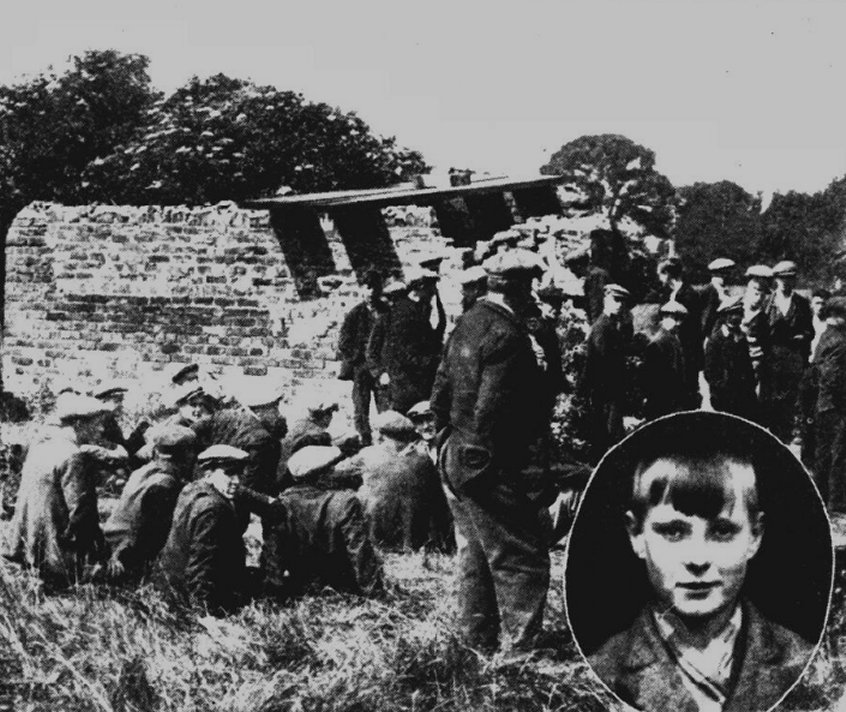
Desperate but unavailing attempts to rescue a boy from drowning in a disused pit shaft were made at Newhill, Wath, on Monday night. Lights were lowered down the shaft by miners armed with ropes, but no trace of the boy could be seen. At great personal risk Mr. J. W. Poole, assistant superintendent of the Mines Rescue Station at Wath, descended the shaft equipped with apparatus, but the exploit was fruitless. Dragging operations continued while a crowd of a thousand people, including the boy’s relatives, stood by helpless. The victim was Richard Dalton (11l), son of Leonard Dalton, miner. 39, Riley Road, Wath.
A Splash
About 8 o’clock on Monday night Dalton and three other boys, Alfred Porter, Frank Woodman and Henry Goodison went for a walk. Dalton suggested that they should go bird nesting and mentioning the old pit shaft which he had visited the previous Sunday evening, the four boys went there. Three of the boys searched the bushes in the old pit yard and Dalton climbed an eight-foot brick wall enclosing the shaft. A few moments later the boys heard a cry followed by a “bump” and a splash. They ran to the shaft and discovered that Dalton had slipped and fallen down. It is believed that he had scrambled over the wall into an elder bush growing on the inside of the shaft.
Prompt Help
The boys gave the alarm immediately, rushing to a cottage in the vicinity. Within a few moments a number of men had reached the shaft, but no sound could be heard and there was no sign of the boy being alive. Probably the bumps heard by the boys were caused by Dalton striking the cross timbers in the shaft. What little the men could do was done promptly . Ropes were procured and to the end of these candles and a hurricane lamp were attached and lowered into the shaft in the hope that the boy would have fallen on to some floating object. The light was so dim that nothing could be discerned. Eventually a message was dispatched to the Rescue Station and within a few minutes Mr. Poole arrived in a car and set to work.
Brave Attempt
By throwing heavy timbers across the walls of the shaft a temporary platform was made. Having put on his apparatus Mr. Poole was lowered down the shaft with a long rope obtained from Wath Main Colliery. The rope was slung over a tour-inch pulley, with some fifteen or twenty men holding on at the other end. It was a very risky job, because the shaft walls are in a crumbling state and there was always the danger of the brickwork caving in upon him. signals were passed to those at the top of the shaft by a small bulb horn forming part of Mr. Poole’s equipment. The shaft is about 300 feet deep and is filled with water up to within about 100 feet of the surface.
After remaining at the water level several minutes, Mr. Poole was drawn out without seeing any trace of the boy. Willing people did all that was possible in the circumstances, and probably others would have gone down had they been permitted. Despite the fact that naked lights continued to burn when lowered, there was some accumulation of gas at the shaft bottom. Mr. Poole told a “South Yorkshire Times” reporter that as soon as he removed the nipple trout from his mouth, he got a whiff. Among the first on the scene were two officials of the Wath Urban Council, Mr. Walter Lightley, general foreman, and Mr. Stanley Askew. Mr. Askew said it was about 9 o’clock when a constable came into the council yard and told them what had happened. They saw it was no use going down the shaft. as the boy could not be seen. but they erected a platform and began to use the drags. There was a certain amount of cross-timber on the water level. Jacob Utley, an old miner, 43, Newhill, said his wife came running to the garden to tell him what had happened. Along with Harry Cotton, Tom Winfield; Frank Ellis. James Carr and others, they secured long ropes and tested the shaft for gas with candles. So far as they could tell there no gas, but it was impossible with the equipment they had to descend the shaft. At the suggestion of Herbert Crossley retired engineman, Hoober View, Newhill, a storm lamp was secured and lowered down the shaft. Later about a dozen miners’ lamps from Wath Main Colliery were procured for the same purpose.
Mr. W. C. Winch, Superintendent at the Rescue Station. said Mr. Poole had thrown his apparatus into the car and set off within four minutes of receiving the call. It was purely voluntary act, not falling within the range of the duties Mr. Poole is expected to perform. Mr. Winch said: “I think it one of the pluckiest things I have ever known. There was no proper equipment on the spot for the purpose and Mr. Poole’s life was in the hands of strangers. There is no knowing what people will do in a moment of excitement. The walls of the shaft are very old slightest slip might have caused the brickwork to fall in upon him. The men at the top could not be expected to understand his signals.
Companion’s Account
One of the boys. Frank Woodman (10), son of Mr. and Mrs. George Woodman. 37, Riley Road. Wath, said that on the night of the tragedy “Dick” said, “We will go to Newhill pit to see if we can find some birds eggs. I went behind a bush near the shaft and Dick went over the wall. He must have been holding on to a branch of the elderberry tree when he lost balance. Dick shouted “Help:” as he fell, and also called out the name of one of the boys. We heard two bumps and a splash and then nothing more Me and Goodison ran to a house below. Some men shouted down the shaft, but there was no answer. Dick said there was a nest in the elderberry bush. He was the only one who went over the wall. Mrs. Dalton, who was almost too distressed to talk, said that before he went out Dick had his music lesson, and was showing his teacher how well he could play. He was a big boy for his age. and was always happy and cheerful. He went off with the paper boys to Newhill, not saying what he was going to do,
Old Pit Shaft
The old mine which was known as Melton Main, ceased working about 48 years ago. It produced coal from the Melton Field seam and a good deal of the output was loaded onto canal barges at Wath. Among those who had watched the efforts to get the boy out was Ben Winder, Newhill, who worked in the mine for 12 years. The old shaft is on enclosed ground some thirty yards off Cemetery Road and the wall round it is about three feet thick.
Body Recovered: A Cool Exploit
On Tuesday evening the body was found and brought to the surface by an unemployed Newhill miner, George Thomas Cutts, 29, Pottery Yard, who descended the shaft without apparatus. He was assisted at the surface by Harry Cotton , Sandymount, Wath; Thomas Winfield, Robinson’s Square, Newhill; Jas. Carr, Albert Carr, and Jacob Utley, of Taylor Row, Newhill; Walter Kettlewell, Old Pit Yard, Newhill; and John Honeyman, Park Rd., Wath. Earlier in the afternoon the body had been partly secured by drags, but it fell away when efforts were made to raise it to the surface. Cutts said he would go down if Walter Kettlewell would supervise the arrangements. Accordingly, the ropes were fastened round his body in such a way that he had free use of his arms and legs. The rope was then thrown over a small pulley erected on a platform and very slowly Cutts was lowered. Cutts shouted instructions. and soon announced that he had found the body. Another rope was lowered, and this Cutts noosed round the boy’s shoulders. Cutts was then raised and after him the body. Mrs. John Walter Kettlewell, who witnessed this remarkable exploit, said everyone was greatly moved by the cool courage Cutts displayed and but for the grim tragedy of the thing the crowd would have cheered. While Cutts was down the shaft a dim light was provided for him by a pit lamp. Cutts was no worse for his experience and returned half-an-hour later to see if there was anything further he could do. The wall of the shaft was partly rebuilt a few months ago and broken glass put on the top to keep children off. The children used to push bricks down to hear the splash. Cutts. who is well known in the Wath district though he formerly lived at Kilnhurst, is secretary of the Newhill Football Club.